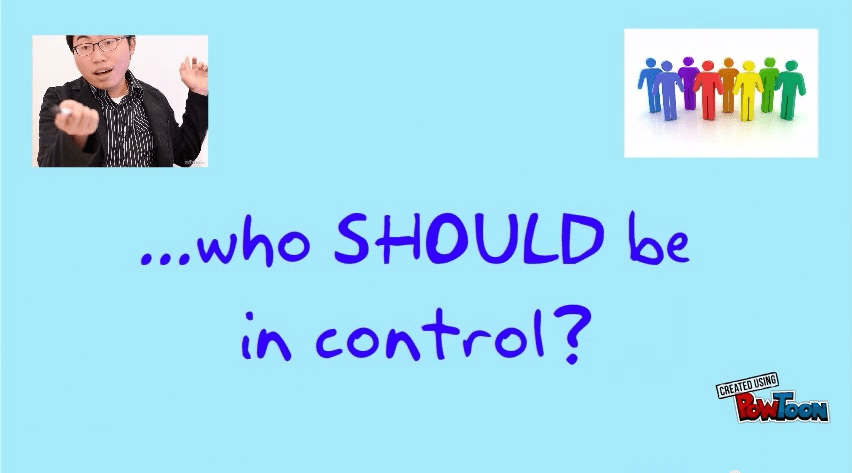
For this week’s EDC534 assignment, we had to read four articles and create a LEAP #4 collaborative synthesis. Producing an entire project via online communication was a first for me. Before I describe the steps of our collaboration, I need to thank my partner, Lauren Wells! We created using four modalities: Google Hangout, Twitter direct messaging, a shared Google Doc, and PowToon. With our busy schedules, online communication was the only way to finish our project. I have a full-time teaching job, two children, and myriad after-school activities; Lauren has a full-time job, two graduate classes, and took her comps during our assignment window.
My own learning definitely took a leap. Lauren reached out during a class Google Hangout, asking for a partner. I used the messaging window to respond, and my first virtual partnership was born. I began using Twitter a few months ago (for this course) but had never used the direct messaging function. I have used Google Docs in the past but have previously shared only one doc (last week, and clumsily so); this was my first successful “can edit” share. Although Lauren is a PowToon pro, I started by watching the site’s tutorials.
With Twitter direct messaging, Lauren and I were able to connect when it was convenient for each of us. We made a basic plan and exchanged e-mail addresses. Next, I started a Google Doc and shared it with Lauren in “can edit” mode. I summarized the readings and Lauren inserted her own ideas. Through Twitter, we divided up the readings and came up with a general theme.
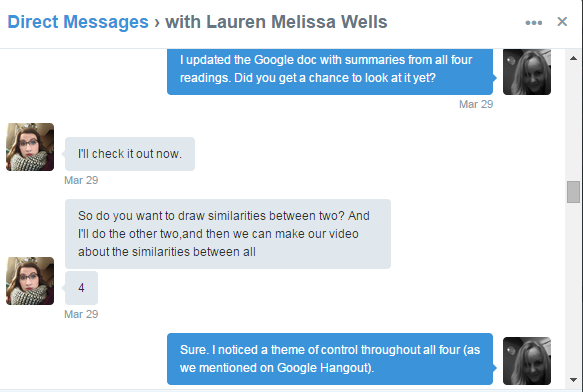

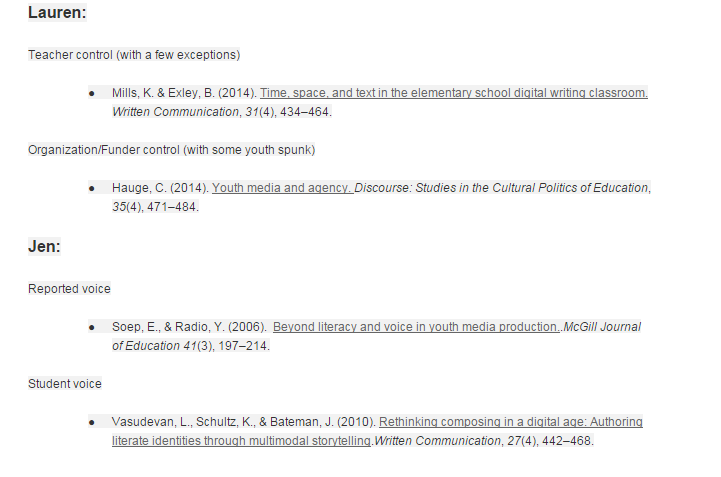
At the beginning of the project, I asked Lauren if we could use PowToon since I never had; she responded that she loved the tool and had used it before. When it was time to start the project, I watched the site’s online tutorials and learned enough to create a basic framework. I chose a theme, set placeholder slides for the four readings, and inserted my content. I also uploaded some photos from Google Images and a few royalty-free songs from bensound.com. I used a small number of the photos and left the rest in the project folder.
Lauren jumped in, added her content, and revised the pacing to add “pop” to our PowToon. Her technical expertise in the tool really shows, with graphic inserts and varying styles. Prior to her revisions, the Toon was uniform but a bit dull. I used a single theme, inserted some photos, and added simple animations. Lauren spiced up the project. She used different colored backgrounds that still fit with the theme and added more sophisticated animations. She made a better title slide and added a question at the end to tie it all together. Lauren selected one of the tunes I found at bensound.com and inserted the background music. I revised the spelling, made some grammatical changes, and removed a redundant slide. At last, our PowToon was born!
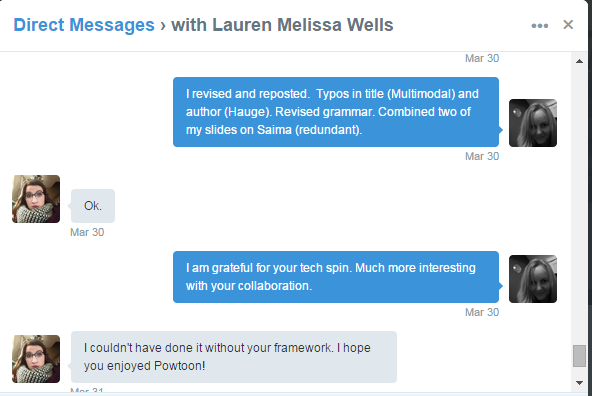
I learned a lot about myself as a collaborator during this project. First, I learned that I could collaborate with someone I’ve never met, entirely online. I learned that while busy schedules put limitations on collaboration, “life” does not have to cease our efforts. As Kara Clayton mentioned during the latest class Google Hangout (March 31), I also like to control my own work and to know when things are going to happen. It was difficult for me to wait for virtual responses but like Kara, I had to trust my partner and know that the work would get done. If Lauren hadn’t taken the chance to ask the entire group for a partner, I wouldn’t have taken the opportunity to work with her. If not for her, my PowToon knowledge would have been limited to beginners’ tutorials. With Lauren’s expertise, my PowToon experience stretched exponentially. While my organizational skills provided the framework for the project and my writing skills provided final edits, Lauren’s technical skills made our presentation much more “watchable.”
I do enjoy working with others during my job as a school library media specialist; I need to keep an open mind when it comes to new types of collaboration.
Prior to this project I assumed nothing would replace my preference for face-to-face collaboration (I am a social animal). Now, I think my ideal collaboration would be face-to-face with a combination of online tools. I appreciated the flexibility offered to us through direct messaging and the ease of collaboratively editing a Google Doc. The Doc gave us an updated version of our efforts and was much more efficient than an e-mail thread.
Overall, I think our collaboration was a success. I’m glad Lauren and I took the LEAP (4) together.
Sources:
Hauge, C. (2014). Youth media and agency. Discourse: Studies in the Cultural Politics of Education, 35(4), 471–484.
Mills, K. & Exley, B. (2014). Time, space, and text in the elementary school digital writing classroom. Written Communication, 31(4), 434–464.
Soep, E., & Radio, Y. (2006). Beyond literacy and voice in youth media production..McGill Journal of Education 41(3), 197–214.
Vasudevan, L., Schultz, K., & Bateman, J. (2010). Rethinking composing in a digital age: Authoring literate identities through multimodal storytelling.Written Communication, 27(4), 442–468.
 tmsjen
Jen, this is an awesome description of your process and reflection on your learning. And your video is great; I’m going to go tweet about it right now! 🙂
LikeLike