EDC534
Reflective Essay #2
As we approach the climax of our EDC534 experience in digital authorship, I am happy to take a moment of reflection. During the first half of our course, we gained context in which to form our discussions about digital literacy. We read and watched course materials and were introduced to many methods of synthesis. As a group we used Google Hangouts, FlipGrid, TitanPad, Popplet, Padlet, and WordPress. Individuals shared their exploration and/or expertise in PowToon, Storify, MovieMaker, iMovie, and more. We built a collaborative community for idea sharing and the foundation for our experiences. During the second half of our course, we have continued our growth. We still use all the group communication tools and many of us have been inspired to “stretch beyond our comfort zones and try new things,” as our instructor, Renee Hobbs, suggests. Our professional discourse has ramped up as we engage in collaborative production and patterns emerge as we link course readings with our own experiences.
During the second portion of our course, I have made significant conclusions. As we learned by watching the “Death of the Author: Simplified” video my conclusions may, or may not be, my own. Still, I share with the enthusiasm of an explorer and a remix artist, the following:
- Power structures are complicated.
- Agency is nothing without audience and evaluation.
- Collaboration can happen anytime, anywhere.
First, power structures are complicated. During our LEAP 4 collaborative project, we synthesized four articles on power structure. We read examples of control by teachers and/or organizations (Mills, Hauge) and we read examples of released control to students (Soep, Vasudevan). We viewed examples of classroom lessons and youth media as well, with varying degrees of student control (teacher control during the Poetry video; student control during the youth media samples). We read and viewed power inversions through Burn & Durran’s “Hospital Dramas” project (popular culture background more helpful than literate background) and in Lange’s book (children prank their parents). This brings me to the question Lauren asked in our collaborative LEAP 4 ending, “Who should be in control?” I believe that a combination of teacher facilitation with student agency is the best scenario.
Here’s our LEAP 4 project:
Mills’ article shows that even when a teacher has myriad technological tools at her fingertips and a structure to impart use of those tools to her students, they may not end up with as much control as intended. This was a convoluted study of Australian students in year 4 classrooms from a culturally diverse school with low socioeconomic status. The study highlighted the challenges faced when a new focus on multimodal texts was introduced into a conventional English writing curriculum. There was a lot of coding by researchers that was complicated and hard to synthesize. The researchers based this coding technique on the work of Basil Bernstein.
“The authors use Bernstein’s theory of the pedagogic device to theorize the pedagogic struggles and resolutions in remaking English through the specialization of time, space, and text” (Abstract, p.434).
There were some meaningful conclusions made during the study; Basically, the technology introduced did not intrinsically shape the way instruction was given. Even when using technology tools, the teachers favored conventional methods of instruction with largely controlled environments. There were some exceptions (ex. separate, quiet spaces for audio recording) but overall, the transformation to multimodal with new classroom structures of time, text, and space, was incomplete. There was little emphasis on free student exploration of the tools and students were often receivers, not producers, of knowledge.
Hauge’s article on “Youth Media and Agency” is an example of corporate control with some youth spunk. Hauge shows that when corporations fund youth media, their agenda can obscure youth mobility and freedom to create an authentic message. In this study, youth in Nicaragua were asked to create a video about a potable water project funded by a joint effort between an IDA and a European donor. Youth initially refused by not responding to the request. Later, the youth produced a video when a competition involving narrative storytelling allowed some creative freedom.
“Amigos de las Americas and a major International Development Agency (IDA) working in Nicaragua, the organizations whose programmes are addressed in this article, provide youth with the tools to build relationships with each other and to communicate with local and global audiences in order to effect change” (474).
In order for the organization to feel good about helping others there are certain definitions placed on the relationship to other. For example, “the relationship of helping the less fortunate other aligns organizations and people from the global north and global south through neo-colonial
histories and relationships.” Organizations intend to empower youth voices. However, the focus on youth as change agents may offer the opportunity for an audience only if the product fits the funder’s message. “Too often the only narratives made visible are the small(er) percentage of youth productions whose stories mirror the desired narratives.” (475).
The youth in the article were aware that a video they created could possibly jumpstart future funding efforts. “In the Contaminación film, the youth make very clear how access to clean water is tangled with coloniality…immobility that situates locals as in need of help to access resources, allowing for the importance and necessity of the benefactor” (479). Although youth in the community expressed an interest in mobility, the organization viewed youth as the future of the community. Therefore, the agency that promoted mobility through youth voice was, in essence, constraining it.
Soep went beyond the traditional studies of literacy and student voice to study a specific method of communication, reported speech. The author notes that the concept of student voice is sometimes romanticized and that often, student productions are thought to empower students by “sharing their voice” or “telling their own story,” but little research has been done on the actual voices students use while creating productions (201).
“This article draws on language data from a single after-school youth media program in a U.S. city, and the analysis centres on a specific linguistic feature, reported speech” (198). The media program in focus is Cutaway, “founded in 1995…located in a major U.S. west coast city, involving primarily working and middle class youth of colour and led by a white artist from a working class family” (202). Students were ages 14-18 and participated in the voluntary, tuition-free program.
Soep cites linguist Deborah Tannen’s definition, “Reported speech includes direct quotations, sometimes attributed and sometimes not, as well as paraphrases, and citations of speech that an actual person has said, as well as occasions when an interlocutor conjures speech that is fully imaginary – presented as if it had been said before, or might be said, by someone else (Tannen, 1983)” (202). The author cites many other researchers’ theories and findings as well, using their words to provide a basis for her study.
Soep notes that “…through reported speech, individual young people weave varied voices into their own utterances, particularly as they prepare and assess their own creative projects” (202). The author observes that, particularly during stressful times of collaboration, students use reported voice to convey a message or to negotiate power.
As Vasudevan, et. al, highlight in their optimistic article, “Rethinking and composing in the digital age…” connecting students’ home lives with their academic lives can yield positive outcomes in student voice. The authors studied a group of fifth-grade students in an urban U.S. school. Their guiding questions related to: 1. the introduction of multimodal texts into classroom curriculum and 2. whether the multimodal expression would shift the students’ identities in the classroom. The article relates the experiences of two students, Michael and Saima, and makes conclusions about multimodal experiences and identity.
Michael, an outgoing, African-American boy, had a “reputation for restlessness” and a lack of academic production. After inviting the entire class into his home, he photographed important elements and verbally shared his life story. His classroom identity later transformed into that of a productive author and a peer leader in the use of technology (461).
Saima had arrived from Bangladesh less than a year prior and was “a shy and physically small girl who wore a traditional Islamic headscarf” (457). She strove to achieve academically but did not maintain a loud presence in the classroom. After being encouraged to tell her story, she connected her culture with multimodal expression and shifted her classroom identity to being recognizable and present.
Vasudevan’s article demonstrates that creating personal, multimodal narratives, when viewed by an authentic audience (in this case, peers) can lead to a stronger identity in the classroom. This caused me to wonder, what if the students in Vasudevan’s study had a wider, authentic, public audience, through the larger community or through an online community? Would the personal narratives translate to the outside audience member, and would the student’s identity continue to grow? What about meaningful evaluation? Would this wider authentic audience provide meaningful opportunities for critical evaluation that would improve the students’ work, their process, and therefore, give them a more powerful voice?
Burn and Durran touched on the power dynamic in their “Hospital Dramas” article. We watched a video about the project as well: http://www.creativeeducation.co.uk/video/305. At the onset of the project, students from television-watching homes (knowledgeable in popular culture) had the advantage over students from “more literary homes… whose parents do not allow them access to television” (65). This caused a power shift in the classroom.
In Kids on YouTube, Lange observed a temporary power inversion when children pranked their parents during family-produced videos. She concluded that “the ephemeral visual inversions of power do not appear to challenge the relational, family hierarchy”(150). In other words, the adult in charge of the family remained in charge of the family after the camera stopped rolling.
This caused me to wonder if the power inversion in the hospital dramas project was ephemeral or permanent. Did the students in the classroom retain any, or all, of their power after the assignment ended? Did they gain a more powerful identity as did the students in Vasudevan’s study? Did the hospital dramas project forever alter the power dynamic in the classroom? How can I shift the power dynamic, ephemerally but frequently, so that each type of thinker gains a power position at some time during my classes? Will this lead to stronger individual identities and exponentially, to a stronger group dynamic? How can I ensure all of my students have agency?
My second conclusion is that agency is nothing without audience and evaluation.
Giving students agency is an effective way to encourage voice. Seeking an authentic audience and conducting meaningful evaluation of youth media are critical when ensuring that student voice will have the power to educate and possibly even change society.
Without audience and evaluation, some youth media is simply unwatchable; therefore, not all youth media is powerful. During week nine, we were asked to watch a number of youth-created videos and to post our comments to a FlipGrid:
EDC534 FlipGrid on Youth Media
I deliberately selected three very different types of videos to watch. The first, Gadolinium, was the most watchable and was produced by high school students presenting their research on an element from the periodic table. This video featured strong collaboration and evidence of learning. Facts were presented with corresponding images to bolster the message. The video was posted to YouTube been credited with approximately 900 viewings (as of mid-April, 2015) so the argument for audience could be made, although we don’t know the authenticity of the audience since we don’t have statistics for particular viewers. Since the video seemed to follow a prescribed format, I assume the teacher handed out a rubric or similar evaluative tool. I do wonder if the students’ work was critically analyzed for content as well as for theme, and whether music was included in the analysis. I wondered this especially during the video’s conclusion when the narrator’s voice over mentioned that “Gadolinium causes a horrible disease…” while happy music played in the background.
The other videos I watched were decreasingly watchable. “The Mermaid,” a video produced by two youth, could be forgiven for its amateur nature by virtue of the participants’ ages (7-12) and for its use of digital tools to complete the task. The stop motion animation using paper cutouts, seemingly filmed with a document camera, used very little dialogue but still conveyed a narrative. While there were some technical errors– a flash of a hand, an ever-present framing of the document camera’s base– there was also a charming story produced by children learning to become digital authors. While this video would not win an Academy Award, it isn’t expected to do so. I’m not sure the project gave students a powerful voice, although it did seem to give them the agency to create their own original story. The third video I watched, “Richard Trim on Video Games,” was the least watchable. In a mumbling 30-second introduction, a teen, male narrator gives the title, “Need for Speed: Pro Street,” and identifies the genre as a race simulator. He highlights features of the video game and touts the ability of the user to customize the cars. What follows is a one-minute screen capture of the game screen, without any further narration. The video includes no title screen, no credits, and no explanation as to why he is sharing this brief opening followed by screen captures twice its length. In this case, I would argue that the student did not display powerful voice. The agency to produce whatever he wanted was, in this case, squandered. The low viewership of the video (5 views as of early April, 2015) would not meet the criteria for Levine’s authentic audience. Even if the student’s video was watched by peers in the classroom, I question the value of this media.
I believe that the students in the study by Halverson, et. al, would have reviewed “Gadolinium” favorably, as it fits a genre (education/research). The creative decisions fit the genre and content. They may have reviewed “The Mermaid” favorably if viewed through the lens of beginning learners. They would not have reviewed Richard Trim’s video favorably, even by the simplistic standards created by the students. While this video does fit in a genre, videos about gaming, the creative decisions do not fit with the genre and there is little content to evaluate. If the researchers’ criteria of reportability (uniqueness) and credibility (believable to an outside audience) were applied, I believe the authors would score these three videos similarly to the student scorers (391).
I believe Levine would rate the Richard Trim video with particularly low scores. In this case, while the video’s narrator seems to indicate the intent to use public voice (reviewing a video game for an online audience), I feel even a private audience of gamers would find the video unwatchable (119). This video does not fit the definition of civic engagement either. I wonder if the teacher’s intent to empower his students, as the website’s “about” page suggests is the primary goal of the school’s YouTube channel, is simplified to the degree that simply posting a video is erroneously viewed as voice.
During week 9, I made continued connections to Burn and Durran, as well as to Lange. My conclusions and questions about the power structure led into the class discussion about authentic audience, and also tied into author purpose. As I watched the FlipGrid responses of my classmates, I made further connections. Many classmates watched the “Gadolinium” video. As Alex and Caighla pointed out, this work shows strong evidence of social roles when collaborating, and connects to Burn and Durran’s article. Alex also connected to Burn’s article, as did I, when watching the collaboration between two young students in “The Mermaid.” While watching “Richard Trim on Video Games” I linked to Burn and Durran a third time, but not in a positive way. I wondered if there was behind-the-scenes collaboration that was not shown. The video is hosted on TruWave Youth Media, a YouTube channel from a college preparatory high school in New York. The “About” page states that “students in the Advanced Media Studies Class maintain the channel” and the goal is to “educate, empower, entertain, and stimulate imagination.” The “Home” page of the channel shows images of students who seem to be affectionate and demonstrate close relationships. Although the video features a single narrator with a narrow focus, perhaps there is more to the context than I am able to view.
I posted my thinking about Lange’s chapter to the class TitanPad:
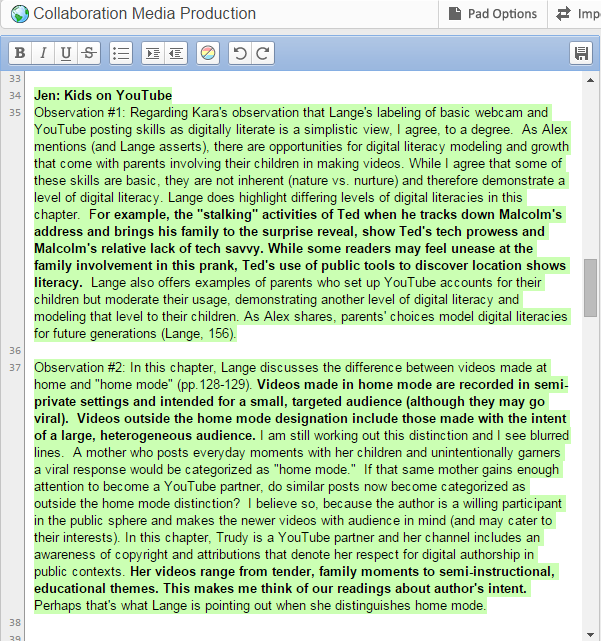
These TitanPad posts about family-produced videos connect me to Barthes’ theory about “The Death of the Author.” When a family posts a well-known prank, like jumping out and scaring someone, to YouTube, is the video comprised of any original content? By changing the players on the stage, can the new video producers claim any authorship? As an audience member, I will certainly add my own experiences to the interpretation of the prank; if I have been similarly pranked I might react with laughter, or horror, as I did when I was pranked. I bring my interpretation to the viewing and construct my own meaning; therefore, the script in my head may differ greatly from the producer’s in-head script, and that may vary many degrees from the original author’s intent. When people work together to create a product, do their varying in-head scripts, created by their unique experiences, shape the video in such a way that each participant views the final, collaborative product differently? Although two people created a video together, are they, in essence, watching two entirely different videos when the play button is pressed? Furthermore, does the play button I press today show the same movie as I’ll see next week, when I’ve been exposed to new experiences. Seemingly, the script would vary each time I view the movie, and so would my partner’s scripts. How many videos did the authors create during the creation of one video? This brings me to my next topic, which has already been interwoven in the paragraphs above.
My third conclusion is that collaboration can happen anytime, anywhere.
Our LEAP 4 collaborative project illuminated a shift into a higher gear of professional discourse. By working with others, many partnering with someone we had never met face-to-face, we were forced out of our individual project modes and into the more complicated, but rewarding, collaborative space. Through this project, I learned that collaboration can happen anytime, anywhere. My partner, Lauren Wells, and I completed the entire project online and have never met face-to-face. I have already included the finished PowToon (our LEAP 4 project) in a preceding paragraph. Here’s link to my blog reflection on our collaborative experience: https://tmsjen.me/2015/03/31/collaboration-and-the-birth-of-a-powtoon/
Just for fun, I made a GoAnimate video about collaboration, with an informal imagined dialogue:
One of the most enjoyable collaborations I experienced during our course was our Google Hangout with guest scholar Michael Robb Grieco. I appreciate the opportunities afforded to us via the Internet. As students we live in many places, our professor’s travels are always an adventure (Where in the world is Renee Hobbs?), and our guest scholar could be in another location. Together, we power up a device, connect to the Internet, and press keys or tap tablets to join a collaborative community. As the Hangout was private, I am not reposting the link here. I have included excerpts from the Hangout below, and I have referenced excerpts with initals: JR for me, Jen Robinson; MRG for our guest scholar. I have also included approximate time notations:
57:26 JR: After referencing the YouTube video Michael Robb Grieco created with Renee Hobbs, “User’s Rights, Section 107” I asked Grieco a question about “… how copyright law ties into student voice and how we’re going to preserve that student voice and opportunities for students to express themselves?”
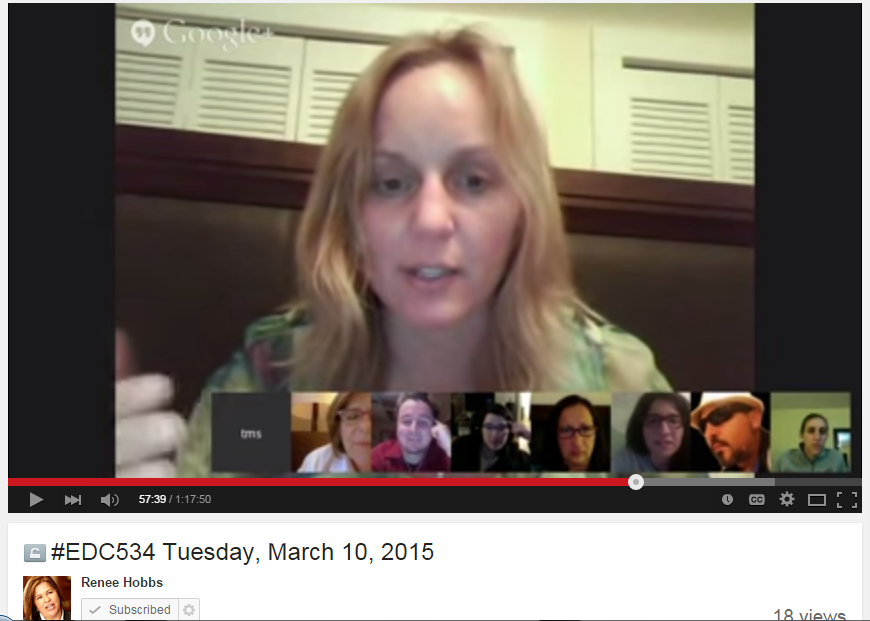
Renee Hobbs commented, “Awesome question!”
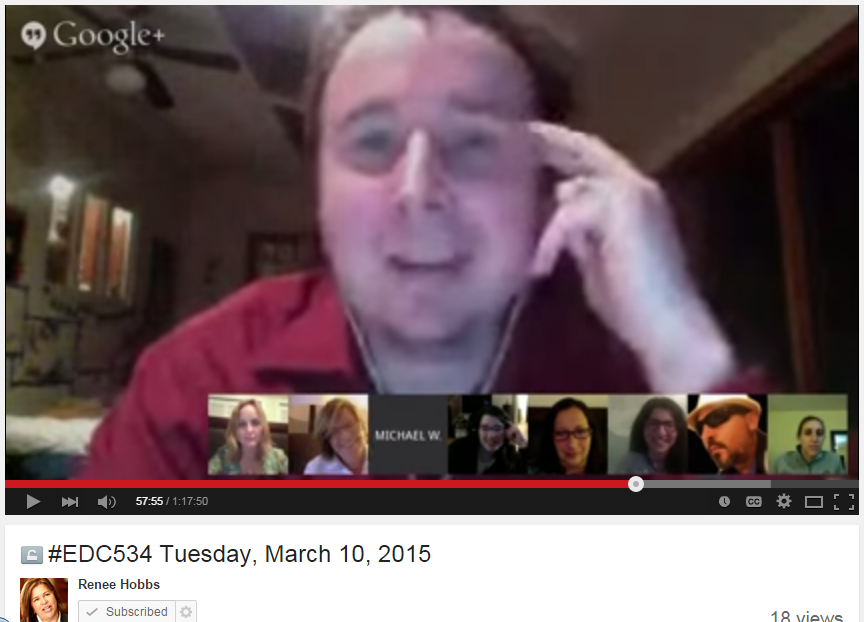
57:55 MRG: “That’’s a great question, and incredibly articulated…”
“I’m a remix artist.” Regarding the theme song for Copyright Law 107 video, “I think I unconsciously, then consciously, ripped off the Friends theme song (sings) ‘I’ll Be There For You…’ while I’m trying to do an 80’s political punk vibe at the same time.”
58:50: “…how I believe creativity works, and how a lot of other scholars believe creativity works, by not only imitation but by using all the cultural resources, especially now– the visual, audio– cultural resources, in addition to ideas in quotes and text and those sorts of things…We’ve gotta be able to play with those things for our voice, ‘cause they are our own voices.”
59:48 MRG: “The fair use principles themselves are really pedagogically useful. They’re really things that we can use to promote critical thinking about authorship, audiences, and the different techniques that we use… What’s tricky is what’s transformative and what’s not transformative.”
I enjoyed the opportunity to have a meaningful dialogue with one of the leading scholars in the field of digital literacy. After both enjoying and learning from the Copyright 107 video, I was eager to make a current copyright law connection. It was interesting to hear Grieco’s ideas surrounding the preservation of student expression and his beliefs about fair use. On a personal note, it was pretty cool to get a compliment about my question, too.
Collaboration reigns throughout the second half of the course. I see it in course readings, as multiple researchers work together to produce a study. I see it during Google Hangouts as we discuss our findings and propose new questions. I see it clearly when watching some videos on YouTube and wonder about the behind-the-scenes collaboration, or lack thereof, when watching other videos. I see it when I read comments on the TitanPad from our group members. I see it when I watch the extraordinary efforts of peers during other LEAP 4 projects. I see it in the lessons that I teach in my library class when I ask for student involvement, such as when we all post to a Padlet. I see it when I plan for, co-teach, or evaluate (informally or informally), a lesson we’ve taught together.
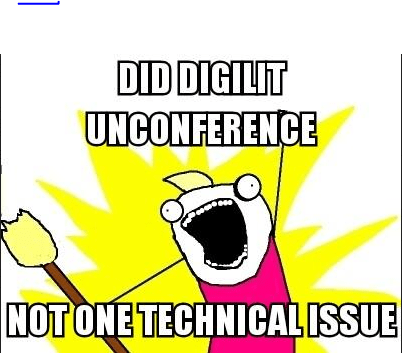
Today in the library I saw collaboration when our digital literacy team shared our favorite online tools with staff members during an unconference. As a team, we discussed individual strengths and planned our presentation using TitanPad: https://titanpad.com/yS5BKU4UXH . We posted our unconference offerings to a Padlet:
and sent an e-mail with the link for teachers to pre-plan their sessions. We set the stage in the library by spreading tables out all over the room, setting up laptop stations with the Padlet for session information, and creating a quick handout with the link for later reference. We posted informal unconference rules: 1. Browse the sessions here (at laptop) or take a flyer; 2. Visit any session you like, and wander the room as you wish; 3. You do not have to stay for an entire session; 4. Have fun!
When it was time for the unconference to begin, we staged ourselves near the large interactive board and invited colleagues to find a spot near the screen. One member, a grade eight science teacher, introduced the concept of an unconference. She explained that there would be a short introductory session, followed by two unconference sessions, and concluding with a whole-group wrap-up. She also acted as timekeeper for our event. Another member, a reading specialist, encouraged colleagues to give the presenter a few minutes to “get the flow” and to see if the topic connected before leaving a session. We wanted colleagues to differentiate between an unconference and an open house event. Still, we insisted that no presenter would have hard feelings if someone arrived late, or left early. Our science teacher pointed out that sometimes, when we start to hear about a tool, we realize we have already used it; that would be a good time to move on and find a new experience. Our technology teacher referred to the Padlet for further information and noted that a second Padlet would be created for teachers to respond to the sessions and share their thinking. Next, each presenter gave a brief talk about his/her featured application to hook the audience and to help them make informed decisions about sessions to attend. I held up two recently charged FlipCameras and asked for volunteers to film any part of the unconference, “like the cameras on your reception tables at a wedding. Film anything you see. We won’t be able to make it to every session so it would be helpful to capture some of the great things going on all over the room.”
With that, we started our unconference. What followed was a cacophony of busy teacher sounds: presenters talking, participants asking questions, keyboards clicking and BYODs of all types swiping and tapping,presenters changing their focus based on colleague questions, people laughing, people saying, “I could do that!” punctuated with a few “Huh?” statements that we hoped to clear up either today or during future sessions. Throughout, the FlipCameras circulated, some teachers took pictures with their phones or tablets, and people got to try something new, if only for a few minutes.
Here’s the tutorial I made for Screencast-O-Matic:
I showed the tutorial, gave the link so teachers could watch it again later if needed, and guided them through the steps of recording their first screencasts. A math teacher asked a question for which I had only a partial answer; his question will lead me to further exploration of, and sharing uses of, Screencast-O-Matic. He is likely to answer his own question before I do. If that happens, I know he’ll share his findings with me. One of us will share with the larger school community, and the chain of new ideas will continue.
We hope our collaboration sparked an interest in each colleague to continue exploring and maybe, learn something that will make our lives a bit easier in this digital world. Here’s the link to our response Padlet:
So far, it looks fairly sparse. I hope teachers add content as they experience the new tools in their classrooms. Time and encouragement will tell.
Our technology teacher sent a meme to me after our unconference:
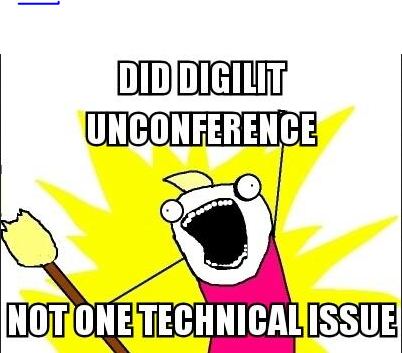
Throughout the course, I have grown leaps and bounds, as a technologist, a collaborator, and a synthesizer. Recently, I formed conclusions:
- Power structures are complicated.
- Agency is nothing without audience and evaluation.
- Collaboration can happen anytime, anywhere.
I look forward to testing these conclusions so that I may see if, indeed, the author is really dead, or simply living a new life in me.
Sources:
Burn, A. & Durran, J. (2007). Hospital dramas: Critical creativity and moving image literacy. Media literacy in schools: Practice, production and progression (pp. 64 – 78).London: Paul Chapman. Video from Parkside School: http://www.creativeeducation.co.uk/video/305
Grieco, Michael Robb. “User’s Rights, Section 107.” YouTube. Renee Hobbs, 10 Dec. 2008. Web. 10 Mar. 2015.
Hauge, C. (2014). Youth media and agency. Discourse: Studies in the Cultural Politics of Education, 35(4), 471–484.
Halverson, E. R., Gibbons, D., Copeland, S., Andrews, A., Llorens, B. H., & Bass, M. B. (2012). What makes a youth-produced film good? The youth audience perspective. Learning, Media and Technology, 39(3), 386–403.
Lange, P. (2014). Video mediated lifestyles. Kids on YouTube: Technical identities and digital literacies (pp. 126 – 156). Walnut Creek, CA: Left Coast Press.
Levine, Peter. (2008). A public voice for youth: The audience problem in digital media and civic education. In L. Bennett (Ed.), Civic life online: Learning how digital media can engage youth (pp. 119 – 138). John D. & Catherine T. MacArthur Foundation, MIT Press.
Mills, K. & Exley, B. (2014). Time, space, and text in the elementary school digital writing classroom. Written Communication, 31(4), 434–464.
Soep, E., & Radio, Y. (2006). Beyond literacy and voice in youth media production..McGill Journal of Education 41(3), 197–214.
Vasudevan, L., Schultz, K., & Bateman, J. (2010). Rethinking composing in a digital age: Authoring literate identities through multimodal storytelling.Written Communication, 27(4), 442–468.
 tmsjen
This is pure gold – wildly synthetic and truly exciting to read.
What an honor to see how you are making sense of these ideas – I am truly humbled.
When the semester is over and you can breathe, we will discuss how to adapt this for publication. It won’t require much to adapt it — It is truly a magnificent work of scholarship! Bravo!
LikeLike
Thanks, Renee. You have completely transformed my experience as a life-long learner and have inspired me to be a better educator. I look forward to continuing the journey.
LikeLike