
Reflection 1 for EDC 532: Seminar in Digital Literacy
AKA: Reflections of a Struggling Reader
AKA: The Reader in Need of a Nap
by Jennifer Robinson
for Professor Julie Coiro
Week 2: Strategic and Engaged Readers
READING #1: Paris, Wasik, & Turner (1996). The development of strategic readers. Handbook of Reading Research, Volume II.
READING #2: Swan (2003). Why is the North Pole Always Cold? In Concept-Oriented Reading Instruction (CORI): Engaging Classrooms, Lifelong Learners
READING/VIEWING #3: View these two 5-minute videos of CORI in action to see first-hand what it looks and sounds like in an elementary school classroom.
READING #4: Chapters 1 and 2 (pages 1-28) in your textbook, Reading, Writing and Literacy 2.0 (Johnson, 2014). What is Literacy 2.0 and What Happened to Literacy 1.0?
STRATEGIC READERS
- What makes a reader strategic?
Strategic readers have clear goals, self-regulate while reading, are aware of gaps in comprehension during reading, and use strategies to close those gaps. These readers are metacognitive; they think about reading while reading, consistently self-assess their comprehension, and construct meaning. Strategic readers utilize their skills before, during, and after reading. They engage with other learners in sociocultural contexts, share their thinking, and learn from others. They apply their knowledge across contexts and reflect on their reading to deepen understanding.
- How do more strategic readers differ from less strategic readers?
More strategic readers differ from less strategic readers in many ways. More strategic readers have a purpose for reading. They know what they want to know and be able to do by the end of a reading session. They make connections across content areas and apply knowledge across situations. They are intrinsically motivated– they learn for the sake of learning. This generates a wealth of background knowledge from which to draw when making connections during the next reading engagement. Strategic readers feel successful when reading and that good feeling causes them to seek out the next learning opportunity, perpetuating the cycle of background knowledge leading to enhanced connections. Strategic readers preview text before reading, skimming text features such as the table of contents, headings, charts, and chapter divisions. They continually self-regulate during reading. They monitor understanding and clarify meaning consistently, returning to prior text in passages as needed to bolster understanding. The combination of comprehension awareness and employed strategies to close gaps highlights these readers’ abilities to decode, interpret, summarize, and synthesize across texts. Strategic readers are metacognitive and are able to explain their thinking to others in sociocultural contexts. When working in pairs or in groups, strategic readers inform others and learn from others. They deepen their own understanding by preparing to share their thoughts with others and glean understanding by listening to others’ findings. Having an authentic audience motivates strategic readers even more. They look forward to the culminating activity and social interactivity and ensure that their work product meets or exceeds the standard.
Less motivated readers, on the other hand, may not have a clear purpose for reading or may lack internal motivation. They read when extrinsically motivated, for example when a teacher assigns a reading, but not just for the sake of learning. They do not take time to preview texts before reading and they may rush through the text without self-regulation. Less motivated readers may not be aware that there are gaps in their comprehension while they read; or, if they are aware of the gaps they may not use strategies to improve comprehension. This could be because they lack the strategies (have not been taught), don’t understand the strategies, or lack the motivation to employ the strategies. These readers are not metacognitive. Their minds may wander during reading or they may just “go through the motions” of reading by holding a text and scanning their eyes down the page. Paris, et al., cited Duffy & Roehler (1987) to support this observed tactic. Less motivated readers may select texts that are too easy and rush through an assignment, feeling pride about “working the system.” They do not seek challenging texts, nor dedicate extra time to tasks. They may be aware of their reading comprehension gaps but feel sociocultural pressures. They may not want to be the last one still reading, nor ask for help in front of peers. Less motivated readers may be less successful in sociocultural contexts surrounding reading. They often lack background knowledge since they read less often and have not built as many connections as more motivated readers have. When connections are not made during reading, the less motivated readers have less to contribute during group discussion and project creation. The reader who does not contribute feels less valued, does not inform others, and may be either reluctant to or unable to benefit from others’ knowledge. Thus, the cycle of less motivated readers is: low intrinsic motivation, less time reading, a shallow well of background knowledge, incomplete or absent self-regulation, low comprehension, limited or absent connections across texts, few sociocultural contributions, less creation of new knowledge.
- What does development have to do with strategic reading and comprehension?
Early readers have much to do when approaching the goal of reading comprehension. They require quality instruction to learn strategies for reading. They sometimes get bogged down in letter identification, phonemic awareness, and word recognition at the expense of fluency. Paris et al., refer to this when they cite Hiebert’s data that “graphic awareness is a precursor of other print concepts” (618). This absence of fluency impedes understanding and the readers fail to construct meaning. Although early readers may have high intrinsic motivation and benefit from high extrinsic motivation by an instructor, they still need time to build the strategies and skills they will use during comprehension. Paris, Wasik, and Turner state that young children are more trusting of text, don’t spot errors in texts, and don’t ask questions when they don’t understand (619-620). They also have difficulty employing the correct strategy for the current need.
Experienced readers, on the other hand, have internalized strategies for reading comprehension and are able to automatically apply skills while reading. Their bank of prior knowledge has currency, their automatic recognition of words preserves fluency, and their ability to connect across texts is more developed. They have, and use, metacognitive strategies while reading. This metacognition leads to higher levels of comprehension.
- What appears to be some of the key research that informs how we currently define reading comprehension and how to teach it to learners of various ages?
Paris et al synthesize key research in their Development of Strategic Readers article. They cite a 1978 study by Myers and Paris, comparing 8- and 12-year-old readers. The study concluded that 12-year-olds are more likely to view reading as not only interpreting symbols but also for constructing meaning” (618). Another illustration of development over time is the Garner study noted in the article. While “preschoolers have a rudimentary understanding of the task of reading,” concepts are further refined in elementary school. Concepts are not fully developed in the minds of some 12-year-olds, but “these factors become more congruent with increasing age and skill (Cross & Paris, 1988)” (619). Regarding metacognition, the article notes techniques by Gambrell and Bales (1987) for teaching mental imagery to fourth and fifth graders and Miller’s (1987) technique for training fifth graders in a “self-verbalization routine that provided purpose, guidance, evaluation, and feedback” (620). The researchers note that experienced readers have not been studied as often as early readers and therefore suggest an increase in the number of studies across developmental stages of readers.
CONNECTIONS/IMPLICATIONS/QUESTIONS/CRITIQUES
- What connections do you see across the texts and ideas?
First, I see several connections across texts in the area of student engagement. Swan both writes about and discusses active learners in the Concept-Oriented Reading Instruction (CORI) article and videos. In one of the CORI videos, she discusses the power of student choice in selecting a text and recommending it to others. This connects to the historical perspectives article we read during week one. The Engagement Era (1996-present) is ripe with ideas for active classrooms. Johnson’s Table 1.2 shows that engaging with texts in digital environments requires active learning, too (11). When shifting from traditional to digital environments, Johnson notes the build in complexity from eye-brain connection to eye-ear-multimodal connection. When reading digital texts, Johnson writes that “purposeful choices” of relevant information must be made (10). This connects to URI’s Summer Institute in Digital Literacy 2015 and Howard Rheingold’s keynote address. The author spoke about mindful use of technology, a topic he covers in depth in his book, Net Smart.
Second, I noticed the word “motivation” in all texts. Paris, Wasik, and Turner highlight the power of motivation when developing strategic readers. They write about motivating students to read through “multidimensional classrooms” that allow many types of expression and ways to succeed (631). Swan’s CORI resources seem to be all about motivation. By allowing student choice in topics, hands-on learning through scientific experiments, and idea sharing from each group, students stay on task and motivated for the duration. Johnson cites research by Coiro and Dobler (2007) and their four findings about successful readers of Internet content (8). The fourth finding is the most directly related to this synthesis. As Johnson summarizes, “Motivation… is very important” (9).
Third, I see a connection about sociocultural contexts across readings. Swan touts the importance of collaboration and idea sharing in cross-content experiences. Paris et al note that peers may influence reading comprehension in positive ways when a reader takes on dual roles as a learner and an explainer (628). The CORI model features collaboration with peers throughout and an authentic audience for final presentations. Johnson discusses sociocultural context in a classroom setting, but also as influenced by a student’s home life. She insists that any contribution by a team member is valuable and equal knowledge is not required (p.12-13). My most meaningful take-away from this week’s readings hails from Johnson’s article. As I struggle to create background knowledge in the field of reading comprehension while synthesizing across texts, I reflect upon this nugget of inspiration: “Learning is not a result of development but development itself” (13).
- What connections do you see between these ideas and things happening in your teaching/learning context? Teaching practices? Student behaviors? Classroom climates?
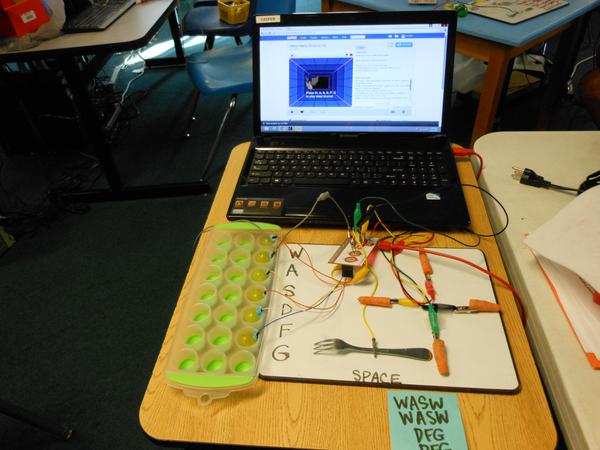
I connect most directly to the CORI reading and videos. These glimpses of cross-curricular, student-inquiry driven, real-world engagement, appeal to my educational senses. This type of synthesized learning is what our team of collaborators strives for in our public, urban, middle school. We model this reading instruction when we partake in meaningful professional development and implement it into our classrooms. Our most recent effort is visible in our computer coding professional development series. As a team, our school’s representatives join with other educators from neighboring cities. Together, we attend sessions facilitated by experts, create projects that tie into our own teaching and learning, and share our ideas during lively demonstrations. As we have already developed prior knowledge and built a skill base for our Scratch coding, we are now challenged to implement this type of learning in our own classrooms. By creating a classroom climate of sharing in a purpose-driven, connected context, we will show our students the value of knowledge. As we implement coding into instructional practice, we still have two days of support during professional development sessions with our collaborative, island-wide consortium.
- What implications do these ideas have for your work in education?
The readings from week two remind me that I need to strive for, maintain, and facilitate an engaged classroom. Instead of traditional lectures with compliant students (I rarely employ this strategy, but it is my occasional fallback) I need to put students at the center whenever possible. Student-driven inquiry, as in our grade six documentary film project, gives students choice and choice activates motivation. Collaboration in sociocultural contexts can yield learning results when readers take on dual roles as explainers. As we found during our island-wide computer coding PD sessions, sharing work with an authentic audience boosts motivation and increases the quality of work products. Finally, I need to remember that this course is a journey. Johnson’s quote that “…learning is development itself” encourages me to stay the course.
- What questions do you have? (e.g., clarifying terms, broader applications, extended wonderings, critiques)
As a novice in the field of reading comprehension, I defer to my extensive wonderings. For now, they outweigh the synthesis. Still, for now, I bid the wonderings rest.
- Do these ideas spark any interests for your final project?
I think I may tie the computer coding PD into my final project. This is something we have been asked to implement into classroom practice and I have yet to do so. Thus far, I have been the learner but not the explainer. Perhaps it’s time to share the excitement.
 tmsjen